

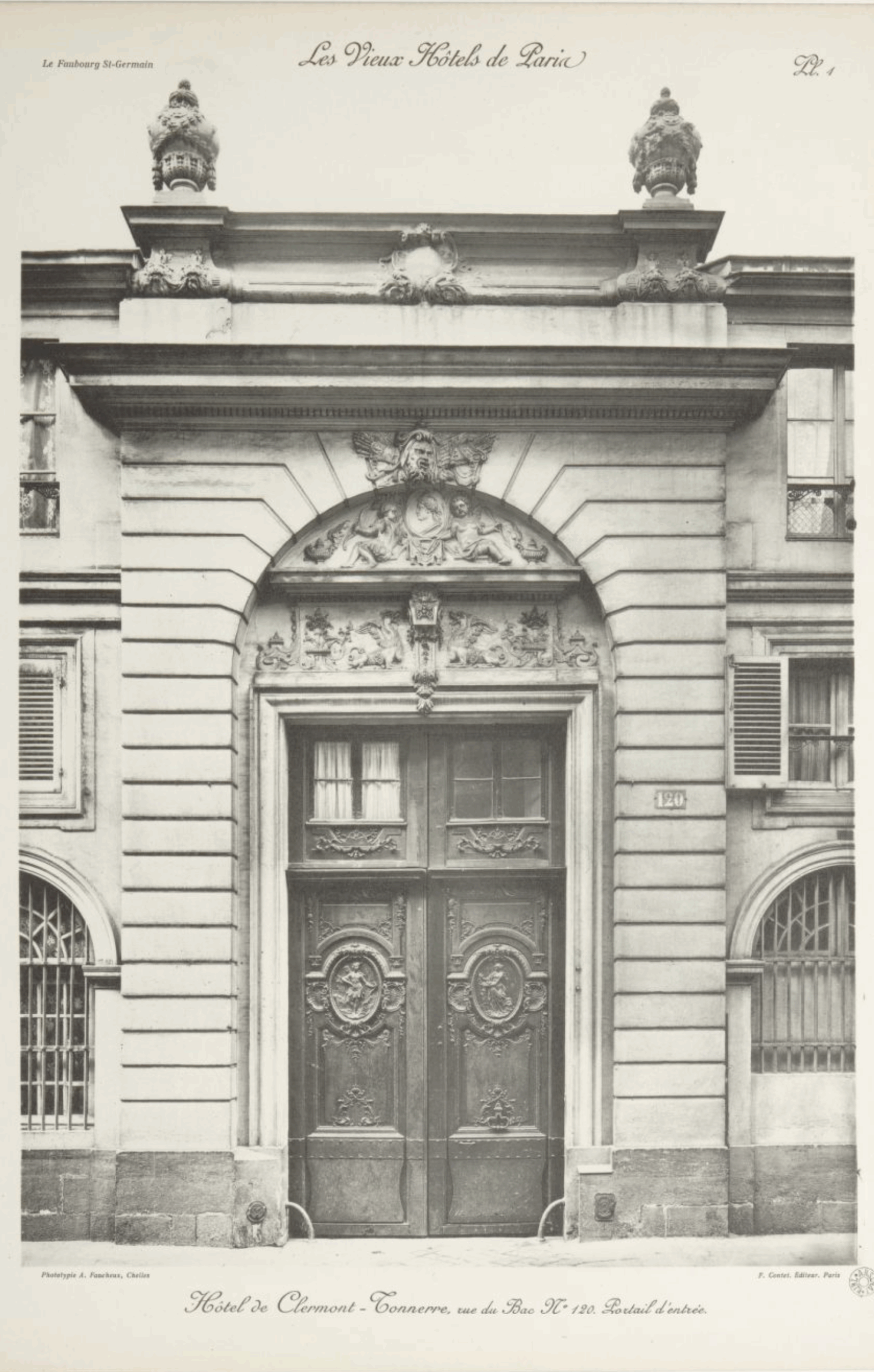
What passer-by hasn't gazed at the white marble commemorative plaque on the façade of 120, rue du Bac? This was the address of François René de Chateaubriand, the former minister and author of Le Génie du Christianisme. It was from this address that, every day at four o'clock on the dot, he set off on parade to perform his vassal's station with Madame Récamier at 16 rue de Sèvres. It was in this hotel that he died, aged nearly 80. His body was laid to rest in the foreign missions church at number 128 rue du Bac, and then transported, followed by Hugo and Ampère, representing the Académie, to the Petit-Bé rock off Saint-Malo, a burial place worthy of the illustrious poet.
By Chateaubriand's time, the building no longer resembled, internally, what it had been in the 17th century. Built, it is said at the time, with number 118 by two bishops from the foreign missions, it was part of the seminary property which today includes numbers 122, 124, 126 and 128 rue du Bac.
The hotels in question have only preserved some of their interior woodwork and cornices, but they have two superb examples of woodcarving on the street, which place them among the most remarkable houses in Paris: the two carriage doors. The illustrations attached to this article show one door and a detail of the other. The wonderful work that embellishes them is the work of the Sicilian artist Toro. The reliefs in the medallions depict four parts of the world: America, Africa, Asia and Europe.
Sources :
Vacquier, Jules. Author. Les Vieux hôtels de Paris : [3e série] : le Faubourg Saint-Germain : tome 1er : [Hôtels de Clermont Tonnerre, d'Orsay, Chanac de Pompadour, de Charolais de Mortemart, Gouffier de Thoix, de Galliffet, de Villeroi, de La Rochefoucauld, Doudeauville, Samuel Bernard, Béthune-Sully, des Invalides] : exterior and interior decorations : historical and descriptive notes (4th ed.)